
One of Dr. Sarah Leary’s patients was treated for medulloblastoma, an aggressive, cancerous brain tumor, when he was 3 years old. Years later, he reached a milestone that says a great deal about the life he built after treatment: admission to a competitive university engineering program.
Yet that kind of outcome can be remarkably difficult to see in research. Medical records capture diagnoses, treatments, scans, and survival. But whether a child grows up to attend college, build a career, or live independently often never makes it into the datasets researchers use to study treatment outcomes.
For Leary, a pediatric neuro-oncologist at Seattle Children’s Hospital and Co-Chair of the Children’s Brain Tumor Network (CBTN) Executive Board, that gap points to the next challenge in pediatric brain tumor research.
“What we mean by ‘best outcome’ isn’t just survival, but survivors thriving, with the best functional outcome possible,” Leary said.
Earlier this year, CBTN and the Pediatric Proton/Photon Consortium Registry (PPCR) announced an effort to connect detailed radiation oncology information with CBTN clinical, genomic, and other research data. The collaboration, introduced in an earlier CBTN blog, Breaking Silos, Accelerating Discovery: The Power of Connected Radiation Therapy Data, is now being tested in two very different pediatric brain tumors: astroblastoma and medulloblastoma.
Together, the two cohorts show what becomes possible when researchers can bring together enough patients and enough information about each one.
When the Patients Are Too Few
For astroblastoma, the first problem is numbers.
The tumor, which primarily impacts children and young adults, is so rare that no single hospital is likely to see enough patients to answer even basic questions about treatment. Cases are spread across institutions, and older records can be difficult to compare as diagnostic definitions and treatment approaches change.
Historically, building a useful cohort meant identifying cases institution by institution, navigating separate regulatory processes, and manually reconciling records that were never designed to work together. Matthew Ladra, MD, MPH, director of pediatric radiation oncology at the Johns Hopkins Kimmel Cancer Center, described a process that could take years before researchers could even address the question.

Matthew Ladra, MD, MPH
Director of Pediatric Radiation Oncology
John Hopkins Kimmel Cancer Center
“With a tumor this rare, no single institution has enough patients to answer these questions on its own. Bringing the data together means we can spend less time trying to build the dataset and more time actually exploring research questions,” Ladra said.
By bringing together cases identified through CBTN and PPCR, researchers can begin studying treatment patterns and outcomes across a much larger group than either network could assemble alone.
The questions are consequential. Researchers want to understand when focal radiation, which targets a specific area, may be enough and when craniospinal radiation, which treats the brain and spinal cord, is necessary. They also want to know whether different molecular forms of astroblastoma respond differently to treatment.
Those distinctions matter because more extensive radiation can affect memory, attention, and learning. If researchers can identify which children need more intensive treatment and which can safely receive less, they may be able to preserve treatment effectiveness while reducing unnecessary harm.
When More Data Creates Smaller Questions
Medulloblastoma presents almost the opposite challenge.
Compared with astroblastoma, more children are diagnosed with medulloblastoma. But researchers now know it isn’t a uniform disease. As molecular research divides it into more specific subgroups, each with different risks and treatment responses, the patient groups become smaller.
That means even a larger pediatric brain tumor cohort can quickly become a small-numbers problem once researchers begin asking more precise questions.
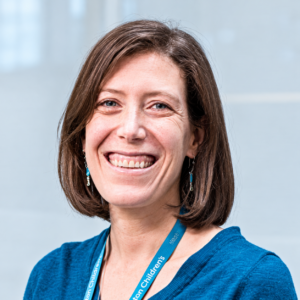
Sarah Leary, MD, MS
Pediatric Neuro-oncologist
Seattle Children’s Hospital
The CBTN–PPCR work is designed to help by bringing clinical, genomic, radiation, and long-term learning and cognitive outcomes into the same research framework. Instead of examining one part of a patient’s experience at a time, researchers can begin studying how those pieces relate.
For some children with medulloblastoma, current treatment already produces very high cure rates. The next question may be whether treatment can safely be reduced to lessen long-term effects. For children with more aggressive forms of the disease, researchers may need to understand where treatment should become more intensive or where new therapies should be introduced.
Leary sees those long-term outcomes as essential. Two treatments may achieve similar survival rates while having very different effects on learning, memory, or daily functioning years later.
Connecting those outcomes with tumor biology and treatment history can help researchers move closer to the evidence families need when different treatment paths may shape a child’s life long after therapy ends.
Building Once, So Research Can Keep Moving
The work behind those questions is painstaking. It requires aligning treatment records, pathology, genomic information, radiation plans, and outcome data collected by different institutions for different purposes.
CBTN data have now been mapped to the shared M3 data model supporting this work. The teams are also developing a secure, federated connection between CBTN and PPCR, allowing the networks to link information while data remain within their existing systems.
That foundation is what determines whether researchers spend years assembling the next dataset or can begin with a system already designed to connect the information they need.
For Ladra, the long-term opportunity is the ability to pursue questions that once demanded enormous time and infrastructure, including how radiation affects specific parts of the developing brain and how treatment plans might better protect learning and memory.
Leary also sees the connected data supporting smarter clinical trials and helping researchers learn from patients treated outside traditional studies.
That is what makes astroblastoma and medulloblastoma valuable beyond the individual cohorts.
One tests whether researchers can find enough patients when a disease is extraordinarily rare. The other tests whether they can connect enough dimensions of a patient’s experience to make treatment more precise. Together, they are helping build a framework meant to work across that spectrum.
Behind every record is a child or family who chose to contribute data to research. The goal is not simply to build a larger collection of information. It’s to make sure researchers can keep learning from it, so the next difficult question begins with more of the picture already in view.